CatmapInterface.jl
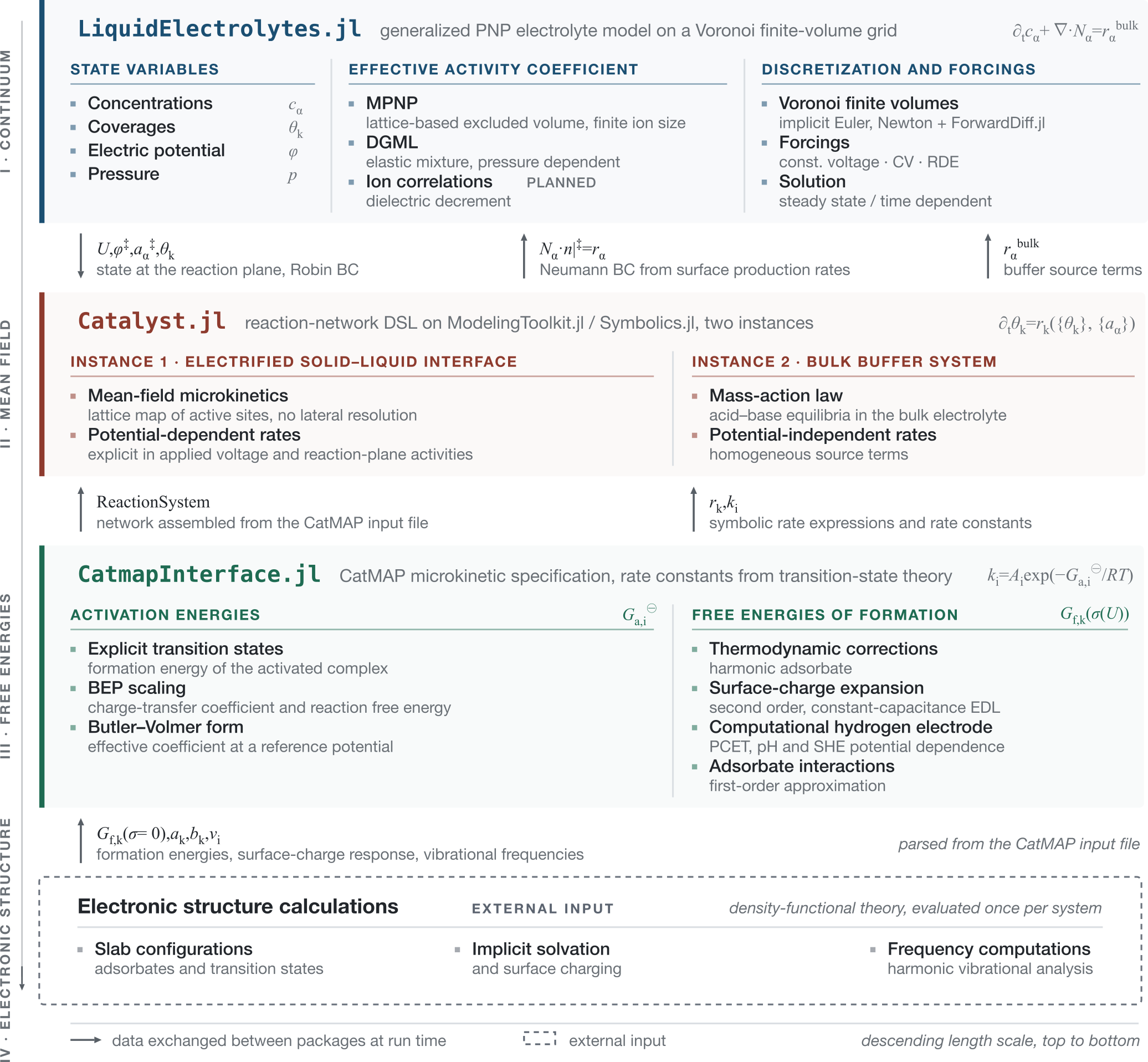
CatmapInterface.jl reads a CatMAP microkinetic specification and turns it into the rate constants a simulation needs, using transition-state theory. Activation energies come either from explicit transition states, from BEP scaling relations, or from a Butler-Volmer form referenced to a chosen potential; free energies of formation are assembled from thermodynamic corrections, surface-charge corrections, the computational hydrogen electrode and adsorbate interactions.
It is one layer of a Julia stack. Catalyst.jl expresses the reaction network — once for the electrified solid-liquid interface with potential-dependent rates, once for the bulk buffer equilibria with potential-independent ones — and LiquidElectrolytes.jl solves the resulting generalised Poisson-Nernst-Planck problem on a Voronoi finite-volume grid. Energies enter from electronic-structure calculations of slab configurations with implicit solvation and vibrational frequencies.
This page is new: please check the description and add a documentation link.