Understanding the role of gas diffusion electrodes in steering the CO2 electroreduction pathway
Abstract
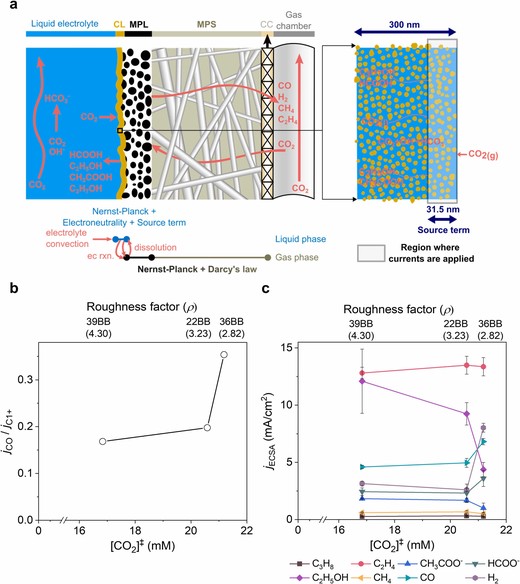
Electrochemical CO2 reduction reaction (CO2RR) offers a promising route for converting CO2 into value-added chemicals. GDEs are pivotal for pushing CO2RR toward industrial competitiveness, yet the GDE macro- and nano-structural parameters and their relationship with CO2RR performance remain unclear. Here, we experimentally quantified the intrinsic and extrinsic properties of Cu-based GDEs (28BC, 22BB, 39BB, 36BB) and their CO2RR performance, integrating this with mass-transport simulations. From this, we constructed a GDE structure–CO2RR activity map that reveals two operating windows: A high-current-density (HCD) onset region (-1.50 V (vs. SHE)) at which product selectivity is governed by surface roughness which drives the re-adsorption of CO and further reduction to oxygenates, and competition for surface adsorbed hydrogen. Deeper in the HCD regime (-1.63 V (vs. SHE)), optimal activity requires balancing CO2 transport with surface adsorbed hydrogen coverage, exemplified by one of the GDEs (22BB), whose high roughness and low microporous-layer porosity deliver the highest intrinsic rates for both hydrocarbon and oxygenate pathways while suppressing hydrogen evolution. These findings identify roughness and porosity as the primary, tunable levers for steering Cu-GDE product selectivity, provide actionable design rules for next-generation CO2 electrolyzers and important mechanistic insights.