Conjugated Polyelectrolytes with Tunable Ionic Side Chains for Iodide-Mediated Pt Reduction in Photoelectrochemical H2 Generation
Abstract
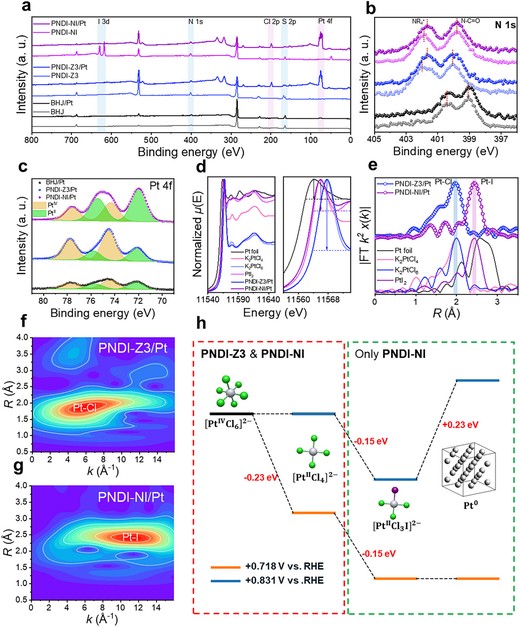
Effective hydrogen generation in organic photoelectrochemical cells (OPECs) requires precise interfacial engineering to achieve uniform metal catalyst deposition, with enhanced water wetting and efficient charge transfer on the hydrophobic organic photoelectrode surface. Herein, we introduce n-type conjugated polyelectrolytes (CPEs) as electron transport layers to address these challenges. Two CPEs based on a naphthalene diimide backbone with distinct ionic substituents were investigated: a zwitterionic sulfobetaine (PNDI-Z3) and a quaternary ammonium iodide (PNDI-NI). Both CPEs significantly enhance surface wettability and promote uniform Pt nanoparticle deposition compared to photocathodes without CPEs. Notably, PNDI-NI enables iodide–chloride exchange with platinate precursors, accelerating the photoreduction of PtIV to PtII and ensuring strong immobilization of Pt species. Further reduction to metallic Pt0 occurs during PEC operation under applied reduction potential. Density functional theory (DFT) calculations confirm the pivotal role of iodide in facilitating this reduction pathway. The resulting PNDI-NI-modified photocathode achieves a photocurrent density of 17.7 mA cm−2 and an applied bias photon-to-current efficiency of 8.88%, representing the highest performance among reported organic photocathodes, alongside superior operational stability confirmed by chronoamperometry. These findings highlight ionically engineered CPEs as a promising strategy for coupling efficient Pt deposition and reduction with enhanced photoelectrochemical performance and durability of OPEC devices.