Peaks and pitfalls of electrocatalytic CO2 reduction descriptor models
Abstract
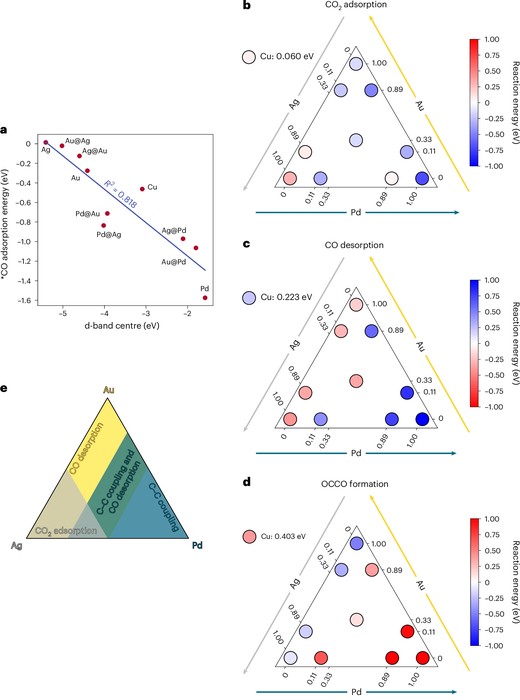
Identifying activity descriptors is critical for the development of efficient electrocatalysts. Here we systematically investigate the effect of electronic structure variations of metal alloys on the electrochemical CO2 reduction. For this, we prepare gold, silver and palladium alloys of various compositions, allowing to continuously tune the d-band centre and work function. Our results indicate that while the d-band centre is the decisive factor for CO production, the work function is needed additionally to explain the production rate of HCOO− and H2$. By contrast, non-metal alloys with matching copper-like descriptor values showed no C2+$ product formation. This breakdown of the descriptor model is explained from first-principles calculations by the heterogeneity and coverage distribution of the surface, which affects the multi-step reaction pathways for C2+ product formation. Our results highlight the problems in transferring conventional descriptor models to more complex, heterogeneous materials and multi-step reaction pathways.