First-principles multi-scale design of gas diffusion electrodes for electrochemical CO2 reduction
Abstract
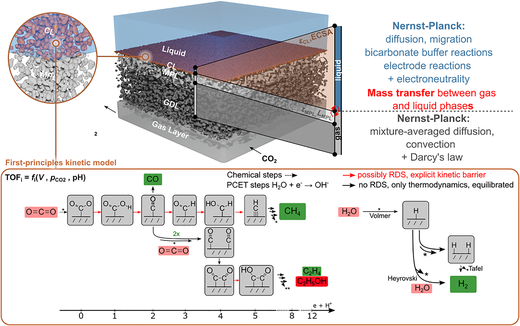
Electrochemical CO2 reduction in copper offers a route to valuable fuels and chemicals, but performance strongly depends on the design of the electrolyzer, which is not yet well understood due to the multiscale complexity of coupling kinetics and transport. Here, we address this using a first principles multiscale modeling framework for gas diffusion electrodes. By constructing digital twins of previously reported experimental electrolyzers, the simulations identify two critical cell design parameter groups that control spatial product selectivity: (1) electrochemical surface area of the catalyst, which governs current densities across the catalyst layer and voltage range; and (2) catalyst support properties, which govern activity near the gas inlet at high currents. Under the latter conditions, high outflow of gaseous products blocks the incoming CO2 gas, a process strongly influenced by the pore size of the substrate. We also present evidence for product selectivity regions within the catalyst layer and their sensitive dependence on GDE design. This work extends the scope of first-principles simulations to shed important light on the multi-scale complexity of modern electrolyzers.