Our new paper in Nature Communications is out! A big congrats to Dianwei Hou!
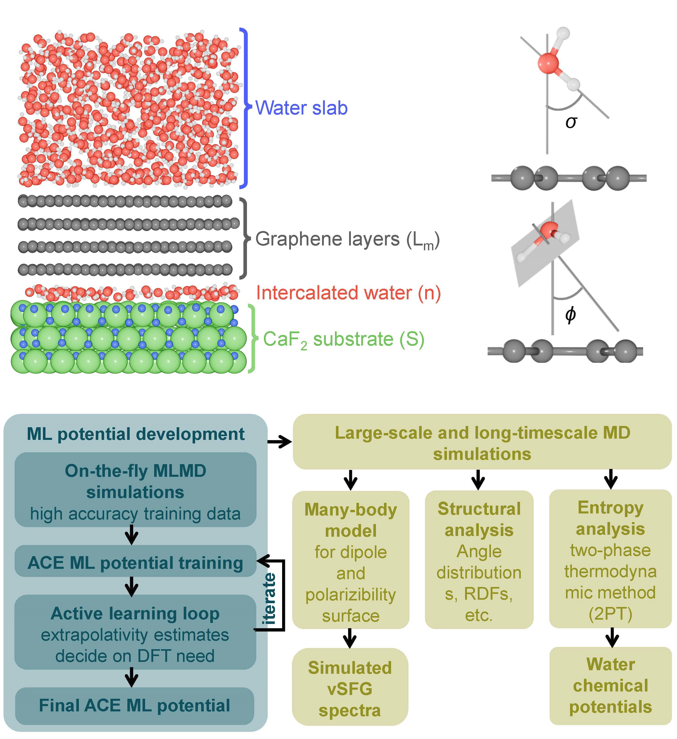
Our recent study (https://www.nature.com/articles/s41467-026-71053-3) not only shows what cool research we can not do with machine-learning interatomic potentials (MLIPs), simulating 1000s of atoms for 10s of nanoseconds at quantum chemical accuracy, but also highlights the transferability limitations of such when it comes to reaching (sub-)chemical accuracy. The wettability of graphene has been a long-standing debate in science and is important for many energy and electronic applications. In this collaboration with Minhaeng Cho (IBS at Korea University), my Postdoc Dianwei Hou pushed the accuracy limits of MLIPs to the max, by resolving water changes at supported graphene interfaces (differing in energy by a few tens of meV). We had to train different ACE models for the different systems to reach the required accuracy level. The simulated sum frequency generation spectra showed that previously reported water structure changes as a function of graphene layers are likely due to water intercalation between the substrate and graphene. In general, graphene stays microscopically hydrophobic and not wetting transparent